"There can, in fact, be no magic and no gods in the
realm where the craftsmen rule. These things require something that the Kalimurans refuse
to yield... belief."
-Unvar Ilethus, Mage Priest of Vorkayne

|
|
| Proper Name | The Republic of Kalimura |
| Ruler | His Most Enlightened Potentate of Knowledge, Scourge of Magic, Leader of the Ironwrights, Prime Minister Albert Myrasen, the Clever |
| Estimated Population | 12,400,000 |
| Demographics | Human 30%, Dwarven 25%, Grum 15%, Elven 11%, Karthasian 8%, Phellysian 5%, Orc 4%, Ogre 2% |
| Adjectival/Demonym | Kalimuran/Kalimurans |
| Languages | Southern 80%, Drakkellin 15%, Elven 5% |
| Capital City | Orrojek (Population: 135,400) |
| National Colors | Red and grey. |
| Year Founded | 1523 |
| Currency | Kalimuran bills of credit |
| Natural Resources | Methkari crystals, lumber, coal, granite, iron ore, copper. |
| Manufactured Goods and Major Exports | Methkari crystals, timber, quarried stone blocks, weapons, armor, ships, timber. |
| Wealth | Very Wealthy |
| Government Type | Democracy |
| Government Stability | Very Stable |
| Allies | Drakkellian Alliance |
| Enemies | Myria |
| Technology Level | Pre-Industrial |
| Primary Religion | None |
| Other Religions | None |
| Climate | Temperate |
| Approximate Land Area | 2,000,000 square kilometers |
| Arable Land | 40% |
| Terrain | Coastal grassland |
 |
|
Kalimura is an anacronism of sorts... a nation of science, engineering and technology in a medieval world ruled by magic and faith. Kalimura is a technological nation where science and progress are praised and magic is outlawed. Within the nation of Kalimura, magic and wizards are actively discouraged. Enchanted items are best kept hidden away and wizards will find discrimination everywhere.
Within the capital city of Orrojek, all magic is banned. While the Kalimurans themselves are polite and civilized, visiting wizards will be met with a subtle air of disapproval. Furthermore, wizards are forbidden from casting spells within the city. Enchanted items will be confiscated and actually casting a spell within the city walls is a punishable offense. This ban on magic applies to priests of certain faiths who also have magical abilities.
However, this prejudice is limited to wizards and priests. As far as politics and race go, Kalimura is tolerant. All people are welcome here, regardless of their race or nationality. The only intolerance shown in Kalimura is toward spells.
Because of its focus on science, engineering, progress and technological advancement, Kalimura is roughly the technological equivalent to 15th century Europe. Kalimura has developed a number of inventions that can be found no where else in the world. Kalimura produced the finest steel, rivaled only by the dwarves. It's glasswork is unrivaled and the nation has produced spy glasses, telescopes, monocles and spectacles. The nation has recently invented the printing press, movable type and high quality paper. Bound books are nearly as common as scrolls in this nation. Full plate armor is worn here by commanders and knights. Kalimura also produces a type of heavy crossbow with steel limbs with a draw weight exceeding one thousand pounds. Their engineering of gears and mechanisms is unparalleled. Complex traps, locks and mechanical clocks can all be found in Kalimura. Finally, the nation recently developed "black powder". This has led to the recent development of cannons which have started to appear on Kalimura ships and at the tops of guard towers.
Due to vast distances between nations, the lack of efficient long distance communication and the influence of magic in other realms, technology has developed at uneven paces between nations throughout history. Because of its views of science and magic, Kalimura is well ahead of all other nations technologically (and has a vested interest in staying ahead). Much of Kalimura technology is kept within the nation and transporting certain items beyond Kalimuran borders is forbidden.
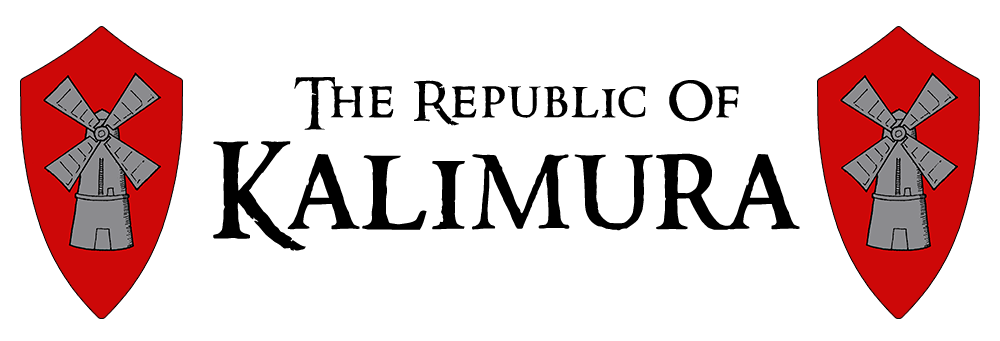
Kalimura is mostly flat, featureless grassy plains in the north. Much of the region is arable and Kalimura has huge tracts of farm land. Wheat and other grains are grown in huge fields that stretch to the horizon. The lands here are known for being quite windy and this wind is harnessed. Windmills are a common sight throughout the realm. These mills turn endlessly to grind the grain to produce bread and more. In fact, windmills are so common that it is featured on the national coat of arms.
With such resources, Kalimura is able to produce a surplus of food which it trades to other nations. Kalimura is bordered on the south by the Iron Hills, an area which is disputed between the Kalimurans and the Myrians. Kalimura is bordered on the east by the Sea of Chaos.
The ekril is a native animal to this region and it is often served in taverns in Orrojek. Kalimurans also favor the sweet red meat of the Stone Beak as well as its large eggs. However, some animals provide much more of a threat. The local forests occasionally have a shimmer cat which pose a danger. On rare occasions, a krallinar will venture north into Kalimuran territory and terrorize a village or two before the militia is able to drive it away.
The Kalimurans do not generally concern themselves with plant lore, but alchemy and herbal healing are popular and well developed to compensate for a lack of magical curatives. Blood root and emerald moss are two common local plants. Battle spice grows here, but the use of it is outlawed within Kalimura. A black market trade exists for the valuable root. Much of it ends up in Drakkellian markets.
Orrojek was founded by a trio - a dwarven master weapon smith, a karthasian scholar and a human craftsman. These three turned their backs on traditional thinking and magic to embrace the philosophy that the Universe could be conquered by science and rational thought and hard work. The location of Orrojek was selected because of a large deposit of methkari crystal there.
Kalimura has had a long history of slow, steady growth. Over the centuries, craftsmen and scholars from all over have settled here to learn and master their trades. In its infancy, Kalimura was not considered a political or military threat and was ignored by the larger nations. Now, Kalimura commands great respect. Although it is smaller than many other nations, its technology gives it the best equipped army in the world.
Kalimura is Ithria's first attempt at a functioning democracy. Certain positions (offices) exists with predetermined powers and responsibilities. A vote of all qualified Kalimuran citizens is taken and officers are assigned. Only citizens which have met strict requirements and paid certain fees are qualified to vote (less than 25% of the population).
The government is ruled by a group of men, each with a specific title and station. These men are "ministers" of their respective organizations within the government. The following titles rule Kalimura:
 |
The Prime Minister |
|
The Minister of Defense |
|
The Minister of Finances |
|
The Minister of Foreign Relations |
|
The Minister of Science |
|
The Minister of Guilds |
|
The Minister of Commons |
|
The Minister of the Guard |
The government is intertwined with the Ironwright Guild to the degree that the guild is the government. The Guildmaster also holds the title of Prime Minister, the chief executive officer of the government. Currently ruling is Prime Minister Albert Myrasen, a master engineer, artist and inventor.
A little known fact about Kalimura is that the government maintains close tabs on certain people in the nation that have "too much" technical knowledge. Any individual craftsman who possesses enough technical knowledge that his emigration to another nation could compromise Kalimuran technological superiority is monitored closely. The group which performs this monitoring, known on the streets as the Watchers, is not officially acknowledged by the government. Virtually nothing is known about its policies or resources, but rumors hint at a complex spy network which extends throughout Kalimura and beyond. Normally, the Watchers are not involved in the day to day affairs of the populace. After all, this group is interested in a very small segment of the population (less than 1 in a 1000).
Kalimura’s system of law reflects its belief in reason, fairness, and civilized order. Trials are conducted on the strength of evidence, and verdicts are rendered without regard for birth or station. Most sentences favor restitution over cruelty—fines, community service or a period of indentured labor to the state or the injured party. Graver offenses may bring imprisonment, the forfeiture of property, or exile from the realm.
Public humiliation and torture have no place in Kalimura. Pillories, gibbets, flogging, and other barbaric punishments are condemned as relics of ignorance. Justice is to be measured, not vengeful; its purpose is reform, not spectacle.
The law is far less forgiving where magic is concerned. The practice, study or promotion of sorcery in any form is strictly forbidden. Wizards caught casting spells are tried swiftly and banished and those entangled in magical contraband rarely find leniency before a Kalimuran judge.
Slavery is likewise outlawed in all its forms. Any slave who steps upon Kalimuran soil is declared free by law, and soldiers are duty-bound to enforce that freedom, even against foreign masters. Yet one crime stands above all others in severity: the theft or smuggling of Kalimuran technology. Such acts are deemed treason against the state and punished by death—the only offense in the realm that warrants execution.
The Kalimuran military is a disciplined, highly trained force, renowned for its organization and technological advantage. Every rank, from foot soldier to Commander General, benefits from the nation’s focus on superior metallurgy, innovative designs and advanced equipment, ensuring that each soldier, sailor, and officer is well-prepared for war. Such equipment includes double crossbows, double mail and fine steel plate armor for the officers. Specialized units, such as mounted knights, archers and artillery, employ strategies that maximize the effectiveness of Kalimura’s innovations.
The army is commanded by Commander General Sath Athogar, who oversees both land forces and their coordination with the navy. Kalimura’s naval forces, though modest in number, consist of the finest and most advanced ships on the sea. The naval fleet is led by Admiral Dras Eldor. Ships and artillery are outfitted with the latest technologies and ongoing modernization plans—such as the gradual introduction of cannons—ensure that Kalimura maintains its edge over any other nation.
Kalimura’s strength lies not only in its equipment but in its people. Soldiers advance through merit, training and proven skill rather than birthright, reflecting the nation’s broader philosophy of rationality and equality. The military embodies the same principles that govern Kalimuran society: discipline, ingenuity, and the harnessing of knowledge for the protection and advancement of the state.
Kalimura’s economy stands among the strongest in Ithria, built upon industry, innovation, and the controlled export of its advanced technology. Kalimuran craftsmanship commands immense value across the continent, yet the state limits the flow of such goods to preserve its advantage. What does leave its borders is sold at great cost — fine steel arms and armor, sturdy ships, precision tools and expertly quarried stone. Timber from Kalimura’s managed forests and grains such as wheat, rye, barley and flax round out its trade, feeding both coffers and neighbors alike.
Drakkel remains Kalimura’s greatest trade partner, and the steady exchange between the two realms has made Kalimura exceptionally wealthy. Rivers of coin and goods flow through its ports and counting houses, enriching guilds and treasury alike.
Beneath its soil lie vast deposits of methkari crystal—the largest known reserves on the continent. Kalimura mines, refines, and cuts these crystals with unmatched precision. Roughly half are exported to trusted allies, while the rest are kept for domestic use. Though Kalimura rejects sorcery, it prizes methkari crystals for their ability to detect magical energies, employing them widely in science, security, and statecraft.
This wealth flows through every layer of Kalimuran society, but never to privilege of birth alone. Citizens advance not by noble lineage but by skill, ingenuity, and contribution to the guilds that drive industry and innovation. The state’s careful regulation of trade, coupled with the prominence of education and craftsmanship, ensures that prosperity strengthens both the nation and its citizens. In Kalimura, the economy is not simply a means of wealth—it is the engine of civic pride, the reward of talent, and the foundation upon which reason and order sustain the realm.
Guided by the philosophy of reason over faith, Kalimura has no churches, temples, or shrines within its borders. Organized religion is quietly but firmly suppressed, viewed as an obstacle to free thought and intellectual progress. The founding of churches, public prayer, and open proselytizing are prohibited by law. Priests from other lands may enter Kalimura, but only under strict agreement not to practice or preach. Those who linger too long soon learn that the watchful eyes of the city guard never stray far.
In the absence of religion, Kalimuran society orbits around profession and craft. The guilds serve as both workplace and fellowship, providing the structure, purpose, and community once found in temples. Education and craftsmanship are the true measures of devotion, and nearly every citizen belongs to a guild suited to their trade or discipline. Social clubs and learned societies flourish, offering outlets for philosophy, art, and scientific debate.
There are no castes, no nobles, and no peasants in Kalimura—only citizens measured by their skill and contribution. Achievement, not birth, determines one’s standing. Literacy is widespread, and institutions of learning—its colleges, universities, libraries and great archives—are counted among the finest in all of Ithria.
Magic is outlawed in Kalimura. There are no schools of magic and no great sorcerers. There are, however, a great number of laws governing magic. Within the city walls, no one is allowed to cast spells for any reason. Violating this law will get the offender banished for life.
Male Names
Anton, Arn, Boris, Gustaf, Henrik, Hubrek, Jerben, Jorran, Josef, Killian, Lars, Ludvik, Pieter, Rubart, Rykard, Sebastiaan, Willem, Viktor, Yurgan
Female Names
Anneke, Calijina, Elvia, Famka, Helena, Ilsa, Jolina, Karenia, Lisbet, Mariska, Patreena, Safia, Tressa, Willemina
Notable Noble Family Names
Burkauer, Dyksver, Graafgoot, Hudeval, Kleijkraft, Kohnlar, Jaagar, Mueldar, Pranz, Rynsborg, Stoeptkan, Theuling, Vilhelmik, Vlyett
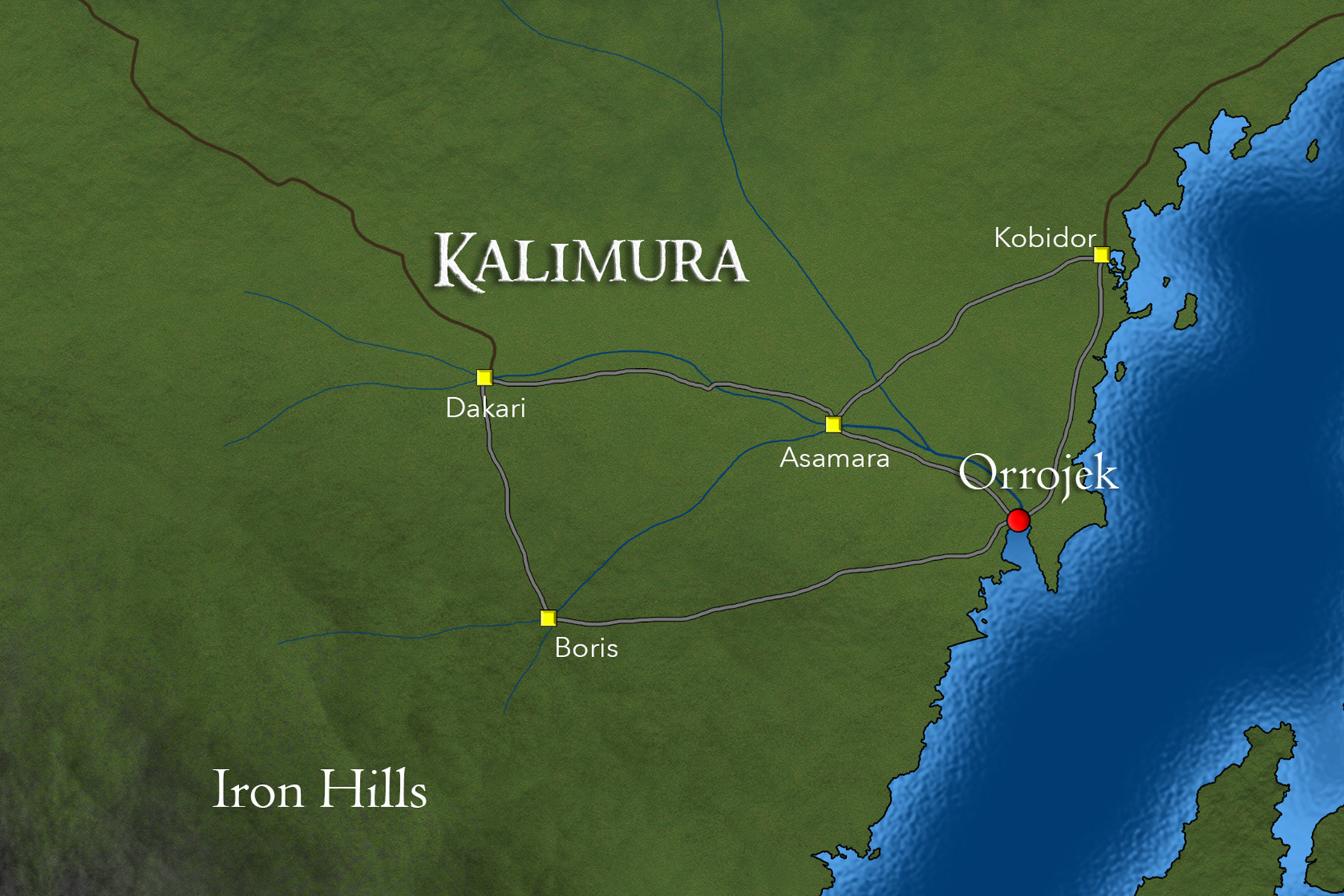
Beyond the south border of Kalimura lies the Iron Hills. These hills have rich deposits in iron, copper, nickel and other useful metals. Kalimura operates several large mining operations in the area which are heavily guarded to protect them from frequent attacks from myrian raiding parties.
| Name | Population | Notes |
| Asamara | 75,900 | The largest town in Kalimura outside of Orrojek. Asamara is known for the production of textiles, clothing, leather goods and armor. Asamara produces some of the finest steel plate armor that can be had. They are also experimenting with fiber combinations to produce a cloth that turns blades. |
| Dakari | 33,700 | This town is known for glassware, pottery and stonework. A number of artists live in this city and the architecture of the buildings is quite beautiful. Dakari is located near the head waters of the Wandering River and is situated to take advantage of the extensive clay deposits in the area. |
| Boris | 18,400 | A town of miners and smiths specializing in all manner of metal work. The villages that mine iron ore from the Iron Hills bring the raw ore to Boris for smelting and forging. This small city provides protection for those villages, patrolling the region and guarding Kalimuran's southern border from the occasional myrian raiding party which comes down from the hills. To ensure the protection of southern Kalimura, a force of 600 mounted warriors patrol the border with the Iron Hills. |
| Kobidor | 9,200 | A coastal town, lying northeast of Orrojek, which cuts timber in the nearby forests and produces the best wagons, ships, shields and other wooden goods. |
Akrobi, Bacharak, Biggs, Corilan, Cronin, Crossroads, Fort Imbar, Fort Ironsides, Fort Laudimyr, Fort Madoch, Fort Tretik, Gulken, Mekelin, Ponder, Quaid, Stagos
Kalimura has a network of excellent paved roads connecting all of its major towns and the capital city. The paved roads are regularly patrolled and relatively safe. Dozens of villages are connected to these main roads by much smaller dirt roads and footpaths. There is also a great deal of river traffic on the Wandering River between the major towns. Finally, Orrojek is a major port city and ships are constantly arriving from and leaving to Penketh, Drakkel and even more distant ports.
For more information, see the Travel and Distance page.
| Typical Travel Time | |||||||
| Route | Terrain/Road Conditions | Distance | Walking | Wagon/Cart | Horse | River | Ship |
| Orrojek - Boris | Paved Road | 604 km | 25 days | 18 days | 11 days | ||
| Orrojek - Asamara | Paved Road or River | 259 km | 11 days | 8 days | 5 days | 4 days | |
| Orrojek - Kobidor | Paved Road or Ship | 365 km | 15 days | 11 days | 7 days | ||
| Asamara - Dakari | Paved Road or River | 447 km | 18 days | 13 days | 9 days | 6 days | |
| Kobidor - Asamara | Paved Road | 402 km | 17 days | 12 days | 8 days | ||
| Boris - Asamara | River | 436 km | 6 days | ||||
| Kobidor - Westkeep | Dirt Road | 606 km | 26 days | 20 days | 12 days | ||
| Dakari - Kilner | Unmaintained Dirt Road | 1,125 km | 50 days | 38 days | 21 days | ||
| Orrojek - Penketh - by ship | Sea | 1,033 km | 11 days | ||||
| Orrojek - Drakkel - by ship | Sea | 1,268 km | 13 days | ||||

This website was last updated August 29, 2026. Copyright 1990-2026 David M. Roomes.
