
"As strong as the pine trees, as hard as the northern
wind, as far in wanderings as the wolf, and as true as North are the men of Kitar."
Proverb

|
|
| Proper Name | The Imperial Protectorate of Kitar |
| Ruler | His Most Magnificent Nobility, Lord of the Snowy Timber, Scourge of the Ogrish Lands, Guardian of the Great Rukemian Empire, Keeper of the King's Relics, King Davillon Arkain, the Unyielding |
| Estimated Population | 4,000,000 |
| Demographics | Human 63%, Elven 11%, Ogre 10%, Dwarven 8%, Borrellian 5%, Orc 3% |
| Adjectival/Demonym | Kitaran/Kitarans |
| Languages | Rukemian 85%, Northern 15% |
| Capital City | Myranor (Population: 107,600) |
| National Colors | Blue, gray and green. |
| Year Founded | 1758 |
| Currency | Rukemian |
| Natural Resources | Lumber (especially ironwood), mountain fauna and flora, cattle, seafood, apples, wheat |
| Manufactured Goods and Major Exports | Timber, foodstuffs, beef, furs and pelts |
| Wealth | Above Average |
| Government Type | Monarchy |
| Government Stability | Stable |
| Allies | Rukemia, War Vale, Normidia |
| Enemies | Duthelm, Borrell |
| Technology Level | Middle Ages |
| Primary Religion | Erylon |
| Other Religion | Barrinor |
| Climate | Temperate |
| Approximate Land Area | 730,000 square kilometers |
| Arable Land | 25% |
| Terrain | Forested hills, grasslands, light forest |
 |
|
This proud nation is the northern province of the Rukemian Empire. The citizenry of Kitar is mostly hunters, woodsmen and craftsmen.
Kitar is heavily forested and takes advantage of this with a population of woodsmen and numerous mills. The Snowy Timber constitutes the bulk of the woods with many smaller forests in the east hills. Central Kitar is devoted to timber while farming and fishing make up the economies along the coast. Kitar is bordered on the east and north by the Sea of Storms and on the south and west by the Krothian hills which are the foothills of the southern Ice Rock Mountains. It is within the Krothian hills that most border skirmishes between Kitar and Duthelm occur. Kitar has a pleasant climate except for its very cold winters.
Wolves, bears, deer and elk are all native to this region. It is not uncommon to see a burrow hound with a group of orcs or even a dragon hound fly overhead. Most of the forests in northern Kitar are mixed or coniferous forests. Bitterberries are the only healing herb in this kingdom of any significance. Packs of wolves roam the Snowy Timber and anger shepherds.
After the dissolution of the Thullian Empire following the Great War, the forested region of the north was home to many small lumber towns and fishing villages. The people of the north were farmers and woodsmen, rangers and lordless knights... fragments of the once great northern empire. When the king of Rukemia was overthrown in 1456 CY and the Rukemian Empire formed, there followed a flurry of activity in the northern towns. Many meetings were held in town halls as fears over imperial tyranny were aired. As if prophesized, imperial troops did come. However, the northerners were ready. Militias were gathered and they were led by the greatest hero of the region, a hunter named Ballok. Well known for his mane of wild red hair and ferocity in battle, many choose to follow him. Ballok engaged the imperial soldiers in the forests that he and the other hunters and woodsmen knew well. By using terrain and devious tactics, several battles won and the imperial advance was halted. Ballok was killed in the final skirmish but his fame had spread wide. Even in modern times, woodsmen will utter an oath in Ballok's name.
Things were quiet for over a hundred years and the northern villages enjoyed a time of peace. Then, in 1758 CY, the Empire annexed Ormek, an independent kingdom to the far south. Fearing the same may happen to them, the woodsmen, rangers and mountain men of the north declared themselves an independent nation, Kitar. One woodsman, by the name of Bael Arkain, who was popular with the commoners, was made king. Shortly after, the northern people began to rebuild the ruins of Bretark and the city of Myranor was founded.
Over the next three decades, the Empire continued to grow and expand its territory. Through these years, border clashes had continued and escalated between the empire and Kitar. King Arkain proved to be a just king and ruled wisely during the young nation's formative years. However, he feared that his small nation would not stand long against the growing strength of the Rukemian empire. In the year 1824 CY, the aging king's son, Prince Verris Arkain , followed an ancient map to ruins in the Ice Rock Mountains and recovered three artifacts from the time of the Great War - a ring, a scepter and a crown. With these three artifacts, an ancient book was also found.
The King's Magus spent months studying the strange glyphs within the ancient tome and the mysterious energies of the ensorcelled relics. Eventually, he was able to decipher their aura and learned that they must "serve one of royal blood". The ancient book described a ritual, which, when performed, would unite the artifacts with a royal master and activate their powers. The King's dying command was that the the ritual be performed upon Prince Verris. That very night, the King died and the Prince ascended to the throne at Myranor. The ritual was performed and the glory of these three artifacts was revealed. The King's Relics, as they were named, were powerful indeed and they helped turn the tide of the war with the Empire. A truce with the Empire was won and the Treaty of 1826 was signed were in Kitar would remain a separate nation but would be unite with the Empire and apply certain imperial laws and pay imperial taxes. In exchange, Kitar would receive military and economic benefits from the Empire. This arrangement has proven fruitful for both sides and today Kitar is the most stable of the four "subordinate" nations ruled by the Rukemian Empire.
In more recent history, Myranor has had trouble with the neighboring kingdom of Duthelm. Duthelm made allies with the orc tribes of the mountains and an extradimensional race of beings that they brought into the world through a magical rift. With these allies, Duthelm began a war with Kitar in early 2009 CY. The war raged for a year and a half culminating in the siege of Myranor during the summer of 2010 CY. With the combined might of Kitaran and Rukemian forces, the siege was finally broken and the hordes of Duthelm routed.
Over the past few years, an uneasy truce as existed between Kitar and Duthelm.
Kitar is a pure monarchy which is ruled by a king and aided by a council of representatives from various areas of the kingdom. Kitar receives a measure of financial and military assistance from Rukemia. Because of this, the King of Kitar answers directly to the Emperor of Rukemia.
The government of Kitar is focused on three powerfully enchanted artifacts of Kitaran history: The Crown of Wisdom, the Scepter of Might and the Ring of Truth. These three items are imbued with great magical energies and grant enormous power to the King. Each item attunes itself to the King when first claimed which occurs in an elaborate ceremony marking the ascension of a new King. The Crown, Sceptre and Ring of Kitar are given with the title of King. They have been passed down from father to son in the ruling line for seventeen generations.
Fair and of moderate leniency. Royally appointed judges hold court and mete out punishment. Slavery is tolerated in Kitar, but only due to pressure from Rukemia. Slavery and association with slave lords is discouraged by most of the public.
The Kitaran Standing Army
Kitar has a strong, full time military force which patrols the kingdom and coast. The majority of these soldiers are housed in small garrisons at every city and town in Kitar. The Kitaran Army also operates a number of the King's Ships. There is no distinction between the land and naval forces. There are only Kitaran soldiers and they are expected to protect Kitar on land and sea.
The Border Watch
In addition to the Kitaran standing army, the lands of Kitar are protected by specialized military force called the Border Watchmen. The Watchmen are 200 lightly armed and armored mounted soldiers who ride fast horses. Their greatest strength is speed and mobility. It is this force that patrols the Duthelm Border and relays messages back to Myranor.
Monthly market day festival is a tradition of Myranor which dates back to its founding. Much trade with the north exists. Resources include fur, lumber, herbs, mercenaries and more. The sea also provides a great variety of resources.
Kitar has the feel of a frontier. Hardy woodsmen, trackers, adventurers and wilderness guides populate the taverns and towns. Kitar is mostly a human nation. However, ogres, grum and dwarves are also common. It is not unusual to see borrellian traders on market day either.
Kitar has few wizards, no great centers of learning and certainly no schools of magic. Magic is a bit more rare here as most folk or farmers, woodsmen or craftsmen. What little magic is here is passed down from master to apprentice.
Male Names
Aljen, Andrin, Balser, Conner, Elikar, Finn, Jeavan, Jahronas, Kolmar, Marko, Nikola, Oskar, Reeko, Vaillar
Female Names
Angiola, Beattie, Dorina, Elena, Grettina, Lucia, Petrica, Ursina, Varena
Notable Noble Family Names
Brunner, Feskar, Grafte, Gruber, Keillar, Hanske, Hauser, Jansler, Moezur, Mueller, Rauth, Schaemitt, Steiner, Stuedar, Woegal, Vydemar
| Village Name | Population | Notes |
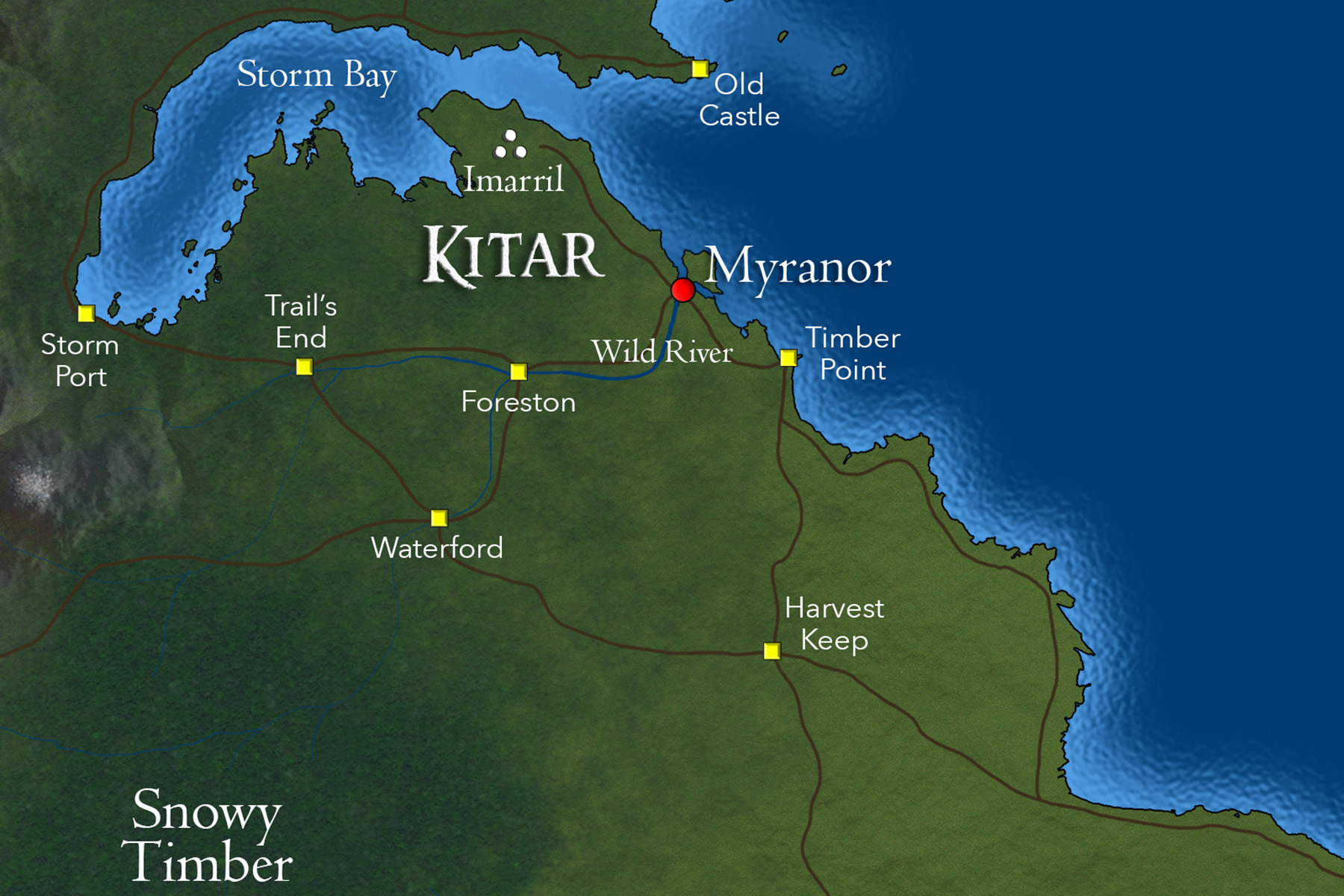
| Timber Point | 58,100 | Centuries ago, logs were rafted down the Wild River toward Myranor. Stray logs would float out to sea and would be washed back into congregrate at this small penisula due to the the arrangement of the local sea currents. This phenomenon led to the peninsula being named Timber Point. The name has persisted for centuries despite the fact that the city does not conduct its own logging. The accumulation of logs at this area led to the town's primary industry - shipbuilding. In addition to ship building, the city is known for excellent fishing and beautiful white beaches. The lord of Timber Point is a man named Lord Kassim. |
| Old Castle | 32,300 | This town is built on top of the ruins of a Pre-Sundering imperial fort. The mayor of Old Castle is Lord Jenon Morgain. |
| Foreston | 19,500 | A logging town built deep in the forest at ground level. Trees are harvested in the surrounding villages and then A number of logging camps sit nearby. Foreston serves as supply depot and recreation center for the loggers. The mayor of Foreston is named Lord Carabas. |
| Trail's End | 16,700 | This town is named so because the man that founded it did so after a very long journey from the northwest. His name and the purpose of his journey are lost to history. The current lord of Trail's End, a man named Gilthen, claims to be a descendent of the founder. Timber Point is often fortified during times of conflict with Duthelm. |
| Waterford | 14,600 | The main road from the Imperial capital city of Aridorn to Myranor crosses the Wild River at this location. The lord of Waterford is Corofen. During times of conflict with Duthelm, log palisades are erected, extra troops are stationed here and Waterford becomes a key staging point for patrols and raids. |
| Storm Port | 8,800 | Storm Port was lost to Duthelm in the last war and the loss is still keenly felt by those who fought the war. Storm Port is populated by people from both sides. Many in Kitar still feel that Stormport is theirs. |
Birdan, Delaine, Durdan, Ferran, Fort Bohl, Fort Hain, Fort on the Hill, Graubun, Hendin, Huebner, Janagar, Kolmar, Kruger, Lark Meadow, Luthera, Old Tavern, Retreat, Stonehaven, Stormkeep, War Grove
Kitar is a heavily wooded region with only dirt roads cutting through the forests. Although goods are rafted downstream from Foreston to Myranor, the Wild River is not navigable upstream from Foreston by any water craft due to many rapids, twists, turns and falls.
For more information, see the Travel and Distance page.
| Typical Travel Time | |||||||
| Route | Terrain/Road Conditions | Distance | Walking | Wagon/Cart | Horse | Riverboat | Ship |
| Myranor - Foreston | Dirt Road | 212 km | 9 days | 7 days | 4 days | 3 days | |
| Myranor - Timber Point | Dirt Road | 153 km | 7 days | 5 days | 3 days | 2 days | |
| Myranor - Imarril ruins | Dirt Road | 249 km | 11 days | 8 days | 5 days | ||
| Myranor - Old Castle | Dirt Road or Sea | 260 km | 64 days | 48 days | 28 days | 3 days | |
| Myranor - Seapoint | Dirt Road or Sea | 1,018 km (sea) |
52 days | 39 days | 23 days | 11 days | |
| Foreston - Trail's End | Dirt Road | 217 km | 10 days | 7 days | 4 days | ||
| Foreston - Waterford | Dirt Road | 214 km | 10 days | 7 days | 4 days | ||
| Waterford - Harvest Keep | Dirt Road | 403 km | 17 days | 13 days | 8 days | ||
| Timber Point - Harvest Keep | Dirt Road | 364 km | 16 days | 12 days | 7 days | ||
| Timber Point - Seapoint | Dirt Road or Sea | 909 km (sea) 1,074 km (land) |
46 days | 35 days | 20 days | 9 days | |
| Harvest Keep - Seapoint | Dirt Road | 702 km | 30 days | 23 days | 13 days | ||
| Harvest Keep - Helmsdale | Dirt Road | 444 km | 19 days | 15 days | 9 days | ||
| Waterford - Dominion | Dirt Road | 591 km | 25 days | 19 days | 11 days | ||
| Trail's End - Storm Port | Dirt Road | 219 km | 10 days | 7 days | 4 days | ||
| Storm Port - Old Castle | Dirt Road | 852 km | 36 days | 28 days | 16 days | ||
| Storm Port - Lair of Kworg | Dirt Road, Lightly Forested Hills |
589 km | 29 days | 22 days | 14 days | ||

This website was last updated August 29, 2026. Copyright 1990-2026 David M. Roomes.
